Loading…
← All schools
University of Richmond
University of Richmond, VAprivate nonprofitrichmond.edu
- Acceptance rateThe share of applicants a college admits in a given year. A 10% acceptance rate means it admits about 1 in 10 applicants.
- 22%
- SAT 25th-75th percentileThe middle range of SAT scores for admitted students: a quarter scored below the low number and a quarter scored above the high number.
- 1410–1530
- Undergrad enrollment
- 2,980
- Net priceWhat a family actually pays after grants and scholarships are subtracted from the sticker price — usually far less than the published cost.
- $31,309
- In-state tuition
- $65,230
- Out-of-state tuition
- $65,230
- Acceptance Rate
- 22%
- On-Campus Housing
- 76% of students
- Most Popular Major
- Business Administration (26%)
- Student-Faculty Ratio
- 9:1
- 4-Year Graduation Rate
- 78%
- 6-Year Graduation Rate
- 87%
- Median ACT (middle 50%)
- 33–35
Quick answers
- What is the acceptance rate at University of Richmond?
- University of Richmond's acceptance rate is approximately 22% (University of Richmond, VA), based on the most recent figures we compiled from public and primary sources.
- What SAT score do you need for University of Richmond?
- Admitted students at University of Richmond typically score 1410–1530 on the SAT (the middle-50% range). Scores outside this band are still admitted, especially with strong applications.
- How much does University of Richmond cost?
- At University of Richmond, the average net price (after aid) is about $31,309 per year. Actual cost varies with financial aid and residency.
- How many undergraduates attend University of Richmond?
- University of Richmond enrolls approximately 2,980 undergraduate students.
- Where is University of Richmond located?
- University of Richmond is located in University of Richmond, VA.
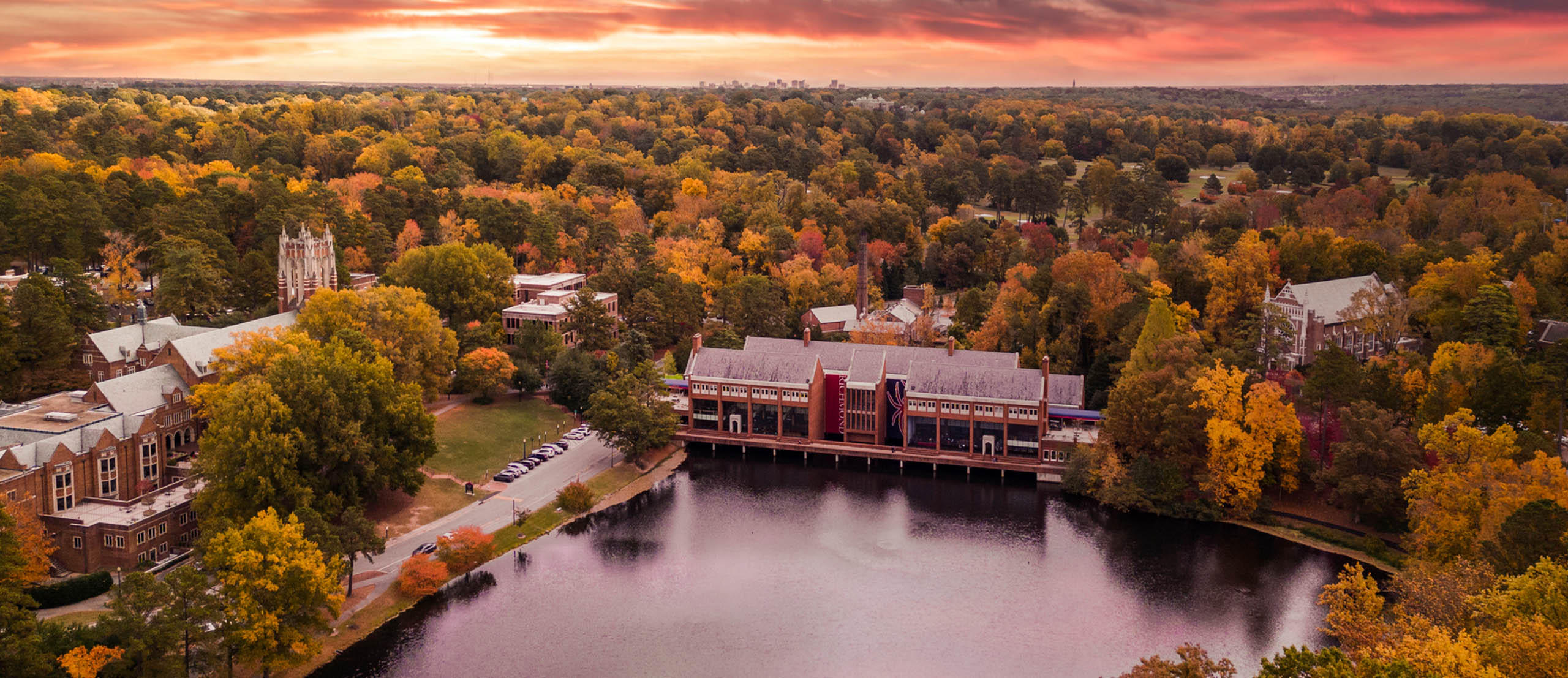
The University of Richmond blends the intimacy of a liberal arts college with the resources of a selective private university, offering a rigorous, interdisciplinary education on a lush, residential campus just outside Virginia's capital. Known for its strong business and leadership programs, Richmond attracts ambitious students with its 9:1 student-faculty ratio, generous financial aid (68% receive some form of it), and a tight-knit community that splits opinions — some find it welcoming, others note its homogeneity. With a 24% yield rate and median graduate earnings of $67,927 six years out, Richmond punches above its weight.
Admissions
Richmond is highly selective, with a 22% Acceptance rateThe share of applicants a college admits in a given year. A 10% acceptance rate means it admits about 1 in 10 applicants. (3,525 admits from 15,121 applicants in 2023) and middle-50% SAT scores of 1450–1520 or ACT scores of 33–35. The average unweighted GPA for admitted students falls between 3.82 and 4.0. Notably, the YieldThe share of admitted students who actually choose to enroll. Colleges watch it closely, which is why some weigh how interested you seem. rate (percentage of admitted students who enroll) was 24% in 2023, suggesting strong competition among peer institutions for these high-achieving students. Applications are due January 1 for regular decision, and 68% of enrolled students receive some form of financial aid.
Sources
- Common Data Set - Institutional Effectiveness - University of Richmond
- [PDF] Common Data Set 2024-2025 - Institutional Effectiveness
- Common Data Set - Institutional Effectiveness - University of Richmond
- Common Data Set: Home
- [PDF] Common Data Set 2022-2023 - Institutional Effectiveness
- Common Data Set Repository - College Transitions
- Student Profile - Undergraduate Admission - University of Richmond
- University of Richmond SAT Scores and GPA - PrepScholar
- [PDF] Admitted Student Profile - University of Richmond
- University of Richmond Admissions - BigFuture College Search
- [PDF] Admissions-Fall 2023