Loading…
← All schools
Stockton University
Galloway, NJpublicstockton.edu
- Acceptance rateThe share of applicants a college admits in a given year. A 10% acceptance rate means it admits about 1 in 10 applicants.
- 89%
- SAT 25th-75th percentileThe middle range of SAT scores for admitted students: a quarter scored below the low number and a quarter scored above the high number.
- 1030–1230
- Undergrad enrollment
- 7,537
- Net priceWhat a family actually pays after grants and scholarships are subtracted from the sticker price — usually far less than the published cost.
- $20,670
- In-state tuition
- $16,266
- Out-of-state tuition
- $24,524
- Avg GPA
- 3.5
- Net Price
- $18,702
- Avg SAT Score
- 1040-1220
- Test-Optional
- Yes (except BS/DO and pharmacy)
- Campus Setting
- Suburban (Pinelands National Reserve)
- Acceptance Rate
- 89%
- Graduation Rate
- 72%
- Most Popular Majors
- Health Sciences, Business Administration
- Students Receiving Aid
- 72%
- Avg Early-Career Earnings
- $51,729
Quick answers
- What is the acceptance rate at Stockton University?
- Stockton University's acceptance rate is approximately 89% (Galloway, NJ), based on the most recent figures we compiled from public and primary sources.
- What SAT score do you need for Stockton University?
- Admitted students at Stockton University typically score 1030–1230 on the SAT (the middle-50% range). Scores outside this band are still admitted, especially with strong applications.
- How much does Stockton University cost?
- At Stockton University, the average net price (after aid) is about $20,670 per year. Actual cost varies with financial aid and residency.
- How many undergraduates attend Stockton University?
- Stockton University enrolls approximately 7,537 undergraduate students.
- Where is Stockton University located?
- Stockton University is located in Galloway, NJ.
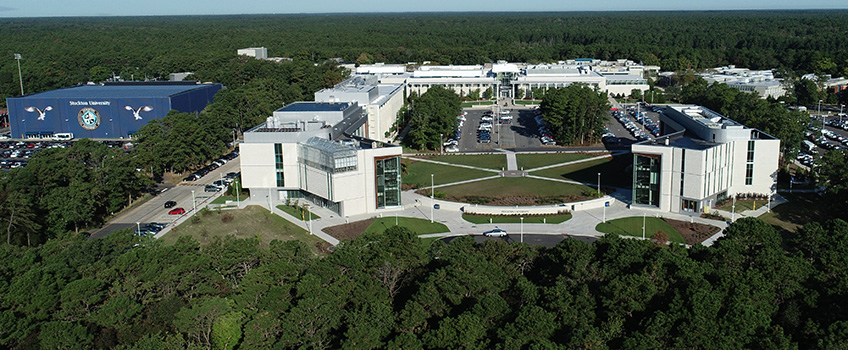
Stockton University is a public liberal arts university in New Jersey's Pinelands National Reserve, known for its interdisciplinary approach and strong health sciences programs. With an 89% acceptance rate and test-optional admissions, it attracts students seeking a practical education with above-average early-career earnings. The campus offers a serene, nature-adjacent setting with active student life—though its reputation lags behind its academic quality.
Admissions
Stockton University is decidedly non-selective, with an 89% acceptance rate (sources vary slightly between 84-89%). The middle 50% of admitted students score between 1040-1220 on the SAT or 23 on the ACT, with an average high school GPA of 3.5. Notably, Stockton is test-optional for most programs—except its accelerated 7-year medical (BS/DO) and pharmacy tracks. Transfer students with 16+ college credits and a minimum GPA are typically admitted. The admissions process prioritizes high school transcripts, with essays recommended but not always required.
Sources
- [PDF] Stockton_University_CDS_2022-2023.pdf - Stockton University
- Welcome - Institutional Research & Effectiveness | Stockton University
- Common Data Set | The Office of Institutional Research
- [PDF] Stockton University - NJ.gov
- Common Data Set: Home
- What is the Common Data Set? | College Raptor
- Stockton University Admissions - BigFuture College Search
- Stockton University Requirements for Admission - PrepScholar
- Stockton University - Tuition and Acceptance Rate - Peterson's
- Stockton University: Acceptance Rate, SAT/ACT Scores - ThoughtCo