Loading…
← All schools
Richard Bland College
South Prince George, VApublicwww.rbc.edu/
- Acceptance rateThe share of applicants a college admits in a given year. A 10% acceptance rate means it admits about 1 in 10 applicants.
- 89%
- Undergrad enrollment
- 894
- Net priceWhat a family actually pays after grants and scholarships are subtracted from the sticker price — usually far less than the published cost.
- $13,045
- In-state tuition
- $9,090
- Out-of-state tuition
- $14,970
- Room & Board
- $9,840–$11,640
- Acceptance Rate
- 70.92–87%
- Graduation Rate
- 21–39%
- Net Annual Cost
- $12,268 (after aid)
- SAT Range (Optional)
- 730–980
- Notable Feeder School
- William & Mary
- Student-Faculty Ratio
- 25:1–27:1
- Highest Degree Offered
- Associate
- Financial Aid Recipients
- 69.4%
Quick answers
- What is the acceptance rate at Richard Bland College?
- Richard Bland College's acceptance rate is approximately 89% (South Prince George, VA), based on the most recent figures we compiled from public and primary sources.
- How much does Richard Bland College cost?
- At Richard Bland College, the average net price (after aid) is about $13,045 per year. Actual cost varies with financial aid and residency.
- How many undergraduates attend Richard Bland College?
- Richard Bland College enrolls approximately 894 undergraduate students.
- Where is Richard Bland College located?
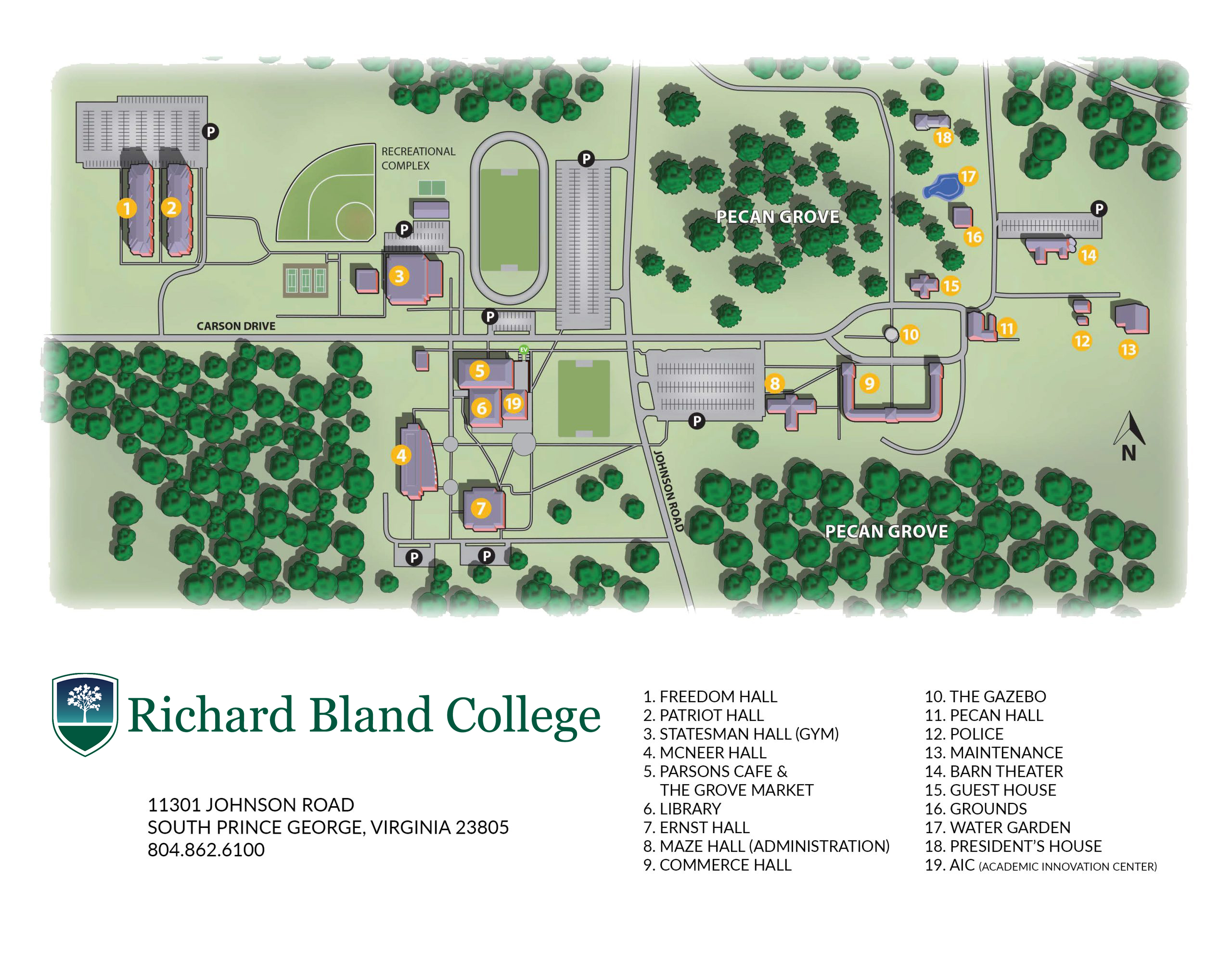
- Richard Bland College is located in South Prince George, VA.
Richard Bland College, a small public two-year college in rural Virginia, offers a no-frills, affordable pathway to four-year degrees—primarily as a feeder to William & Mary. With an 87% acceptance rate and SAT-optional admissions, it’s accessible but struggles with low graduation rates (21-39%). Its rural campus and tight-knit residential community appeal to students seeking a quiet, focused start to higher education.
Admissions
Richard Bland College is highly accessible, with Acceptance rateThe share of applicants a college admits in a given year. A 10% acceptance rate means it admits about 1 in 10 applicants. ranging from 70.92% to 87% across sources. The college is SAT/ACT optional, though submitted scores typically fall between 12-18 (ACT) or 730-980 (SAT). Applicants need only a high school diploma or equivalent (GED), with no strict GPA cutoff. Deadlines are lenient—regular applications are due August 18, making it a viable last-minute option. The admissions process emphasizes simplicity: just an application, official transcript, and optional supplemental materials like recommendation letters.
Sources
- Richard Bland College: Virginia College | Two Year College ...
- Common Data Set: Home
- The Common Data Set: What It Is & How to Use It In College ...
- Where to find Common Data Set (CDS) for college admission statistics
- Application for Admission | Richard Bland College
- Common Data Set Initiative - Institutional Research & Analytics
- Richard Bland College Admissions - BigFuture
- Application Requirements | Richard Bland College
- Richard Bland College - Niche
- Richard Bland College of William & Mary - Peterson's
- Richard Bland College - BigFuture