Loading…
← All schools
Pennsylvania State University-Penn State York
York, PApublicyork.psu.edu
- Acceptance rateThe share of applicants a college admits in a given year. A 10% acceptance rate means it admits about 1 in 10 applicants.
- 97%
- SAT 25th-75th percentileThe middle range of SAT scores for admitted students: a quarter scored below the low number and a quarter scored above the high number.
- 1050–1245
- Undergrad enrollment
- 668
- Net priceWhat a family actually pays after grants and scholarships are subtracted from the sticker price — usually far less than the published cost.
- $19,047
- In-state tuition
- $15,208
- Out-of-state tuition
- $25,392
- Avg. ACT Range
- 21-27
- Avg. SAT Range
- 1060-1260
- Acceptance Rate
- 97.4%
- In-State Tuition
- $15,000/year
- Commuter Students
- 95%
- Student-Faculty Ratio
- 18:1
- 6-Year Graduation Rate
- 11%
- Median Alumni Earnings
Quick answers
- What is the acceptance rate at Pennsylvania State University-Penn State York?
- Pennsylvania State University-Penn State York's acceptance rate is approximately 97% (York, PA), based on the most recent figures we compiled from public and primary sources.
- What SAT score do you need for Pennsylvania State University-Penn State York?
- Admitted students at Pennsylvania State University-Penn State York typically score 1050–1245 on the SAT (the middle-50% range). Scores outside this band are still admitted, especially with strong applications.
- How much does Pennsylvania State University-Penn State York cost?
- At Pennsylvania State University-Penn State York, the average net price (after aid) is about $19,047 per year. Actual cost varies with financial aid and residency.
- How many undergraduates attend Pennsylvania State University-Penn State York?
- Pennsylvania State University-Penn State York enrolls approximately 668 undergraduate students.
- Where is Pennsylvania State University-Penn State York located?
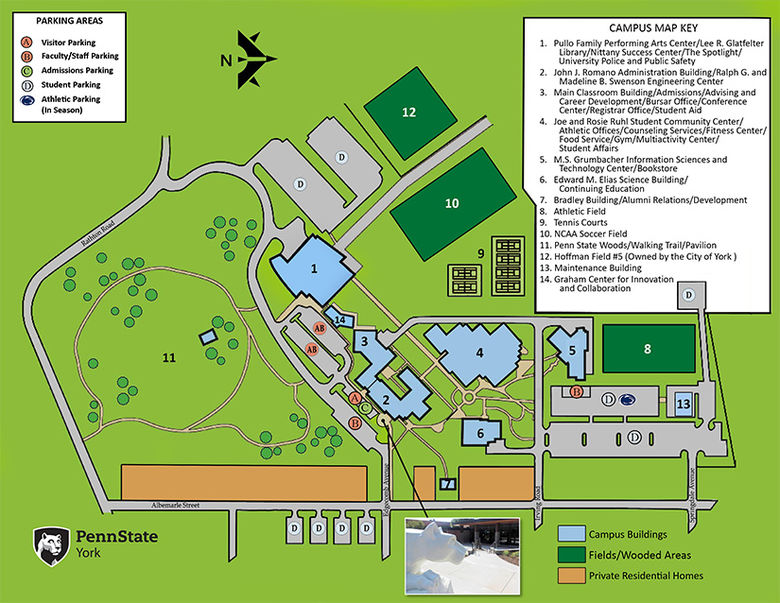
- Pennsylvania State University-Penn State York is located in York, PA.
Penn State York is the scrappy, accessible cousin in the sprawling Penn State system—a commuter campus where nearly everyone gets in (97% acceptance rate) but serious students can tap into the full resources of a Big Ten university. With a focus on practical degrees and smooth transfers to University Park, it’s a low-stakes, high-reward starting line for first-gen students and career-changers in south-central Pennsylvania.
Admissions
Penn State York is one of the most accessible entry points into the Penn State system, with a 97.4% acceptance rate—far higher than University Park’s 55-57%. The middle 50% of admitted students typically have SAT scores between 1060-1260 or ACT scores of 21-27, though test scores aren’t strictly required. Unlike the flagship campus, York doesn’t publish GPA ranges, suggesting a more Holistic admissionsA review that weighs the whole applicant — grades, essays, activities, and context — rather than relying on test scores and GPA alone. process. The campus serves as a popular feeder for transfers to University Park, with rolling admissions and flexible deadlines (applications accepted until June 30).
Academics
This campus offers 12 bachelor’s degrees (including business, engineering, and psychology), , and , with a standout that guarantees transfer to University Park after one year. The small class sizes (average 18:1 student-faculty ratio) contrast sharply with lecture halls at main campus. While York lacks the flagship’s prestige programs, students praise the —especially in STEM fields where faculty often involve undergrads in research. The campus also hosts a rare , catering to local industry needs.
Sources
- Common Data Set | Office of Planning, Assessment, and ... - opair
- Pennsylvania State University 2026 Common Data Set - GradGPT
- How to Use the Penn State Common Data Set - Admit Report
- Common Data Set (CDS) Penn - Institutional Research & Analysis
- Common Data Set | Office of Planning, Assessment, and ... - opair
- [PDF] Common Data Set 2022-2023 - CDN
- Eligibility and Class Profile for First-Year Students - Penn State
- Penn State York SAT Scores and GPA
- The Pennsylvania State University--University Park Admissions
- 2019 Penn State Acceptance Rate: Class of 2023 - Prep Expert