Loading…
← All schools
Maine Maritime Academy
Castine, MEpublicmainemaritime.edu
- Acceptance rateThe share of applicants a college admits in a given year. A 10% acceptance rate means it admits about 1 in 10 applicants.
- 54%
- SAT 25th-75th percentileThe middle range of SAT scores for admitted students: a quarter scored below the low number and a quarter scored above the high number.
- 1095–1260
- Undergrad enrollment
- 942
- Net priceWhat a family actually pays after grants and scholarships are subtracted from the sticker price — usually far less than the published cost.
- $23,414
- In-state tuition
- $15,158
- Out-of-state tuition
- $31,102
- Avg GPA
- 3.4
- Net Price
- $29,641
- Top Major
- Naval Architecture & Marine Engineering (36%)
- Avg SAT Range
- 1095-1260
- Acceptance Rate
- 56%
- On-Campus Housing
- 58%
- Student-Faculty Ratio
- 10:1
- 6-Year Graduation Rate
- 61%
- Median Grad Salary (4 yrs)
- $113,000
Quick answers
- What is the acceptance rate at Maine Maritime Academy?
- Maine Maritime Academy's acceptance rate is approximately 54% (Castine, ME), based on the most recent figures we compiled from public and primary sources.
- What SAT score do you need for Maine Maritime Academy?
- Admitted students at Maine Maritime Academy typically score 1095–1260 on the SAT (the middle-50% range). Scores outside this band are still admitted, especially with strong applications.
- How much does Maine Maritime Academy cost?
- At Maine Maritime Academy, the average net price (after aid) is about $23,414 per year. Actual cost varies with financial aid and residency.
- How many undergraduates attend Maine Maritime Academy?
- Maine Maritime Academy enrolls approximately 942 undergraduate students.
- Where is Maine Maritime Academy located?
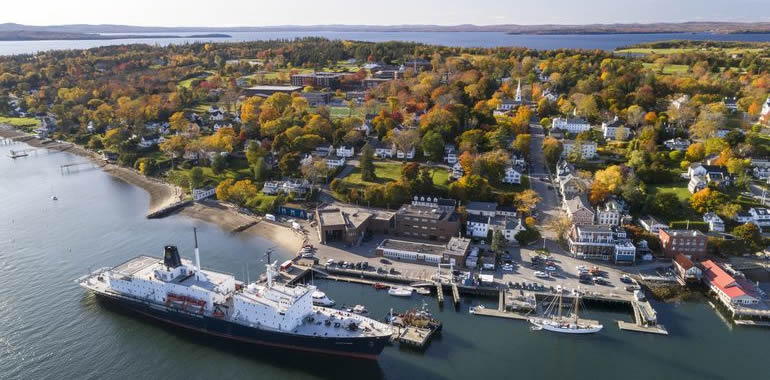
- Maine Maritime Academy is located in Castine, ME.
Maine Maritime Academy isn't just a college—it's a launchpad for high-paying maritime careers, where students trade lecture halls for engine rooms and coastal waters. With a 56% acceptance rate and a regimented student life, this tiny public academy in Castine punches far above its weight in graduate earnings (median $113K within four years) thanks to its hyper-specialized programs in naval architecture and marine engineering. Expect a no-nonsense, hands-on education where 90% job placement meets lobster-boat camaraderie.
Admissions
Getting into Maine Maritime requires more than just decent grades—it demands a tolerance for salt spray and diesel fumes. The academy admits 56% of applicants, with early applicants enjoying a 40.2% Acceptance rateThe share of applicants a college admits in a given year. A 10% acceptance rate means it admits about 1 in 10 applicants. advantage. Middle 50% SAT scores range from 1095-1260 (math-heavy at 530-635 for math alone), while ACT takers average 21-26. Admitted students typically sport a 3.4 GPA, though the school accepts TOEFL scores for international applicants in lieu of standardized tests. Notably, while in-state students benefit from an open admission policy for most programs, out-of-state applicants face selective hurdles.
Sources
- Maine Maritime Academy - IPEDS - Department of Education
- Maine Maritime Academy Overview | CollegeData
- [PDF] Common Data Set 2022-2023 - The University of Maine
- Maine Maritime Academy | US News Best Colleges
- Facts + Figures | Massachusetts Maritime Academy
- [PDF] Maine Maritime Academy First Generation Report
- Maine Maritime Academy Admissions - US News Best Colleges
- Maine Maritime Academy Admissions - BigFuture College Search
- FAQ's - Maine Maritime Academy
- Maine Maritime Academy - Tuition and Acceptance Rate - Peterson's