Loading…
← All schools
Keuka College
Keuka Park, NYprivate nonprofitkeuka.edu
- Acceptance rateThe share of applicants a college admits in a given year. A 10% acceptance rate means it admits about 1 in 10 applicants.
- 68%
- Undergrad enrollment
- 966
- Net priceWhat a family actually pays after grants and scholarships are subtracted from the sticker price — usually far less than the published cost.
- $24,338
- In-state tuition
- $39,332
- Out-of-state tuition
- $39,332
- Location
- Keuka Park, NY (Finger Lakes region)
- Avg Net Price
- $26,153
- Avg SAT Range
- 940–1110
- Acceptance Rate
- 68%
- On-Campus Housing
- 74% of students
- Signature Program
- Mandatory annual Field Period (experiential learning)
- Most Popular Majors
- Social Work, Business, Special Education
- Undergrad Enrollment
- ~1,000
- 6-Year Graduation Rate
- 58%
Quick answers
- What is the acceptance rate at Keuka College?
- Keuka College's acceptance rate is approximately 68% (Keuka Park, NY), based on the most recent figures we compiled from public and primary sources.
- How much does Keuka College cost?
- At Keuka College, the average net price (after aid) is about $24,338 per year. Actual cost varies with financial aid and residency.
- How many undergraduates attend Keuka College?
- Keuka College enrolls approximately 966 undergraduate students.
- Where is Keuka College located?
- Keuka College is located in Keuka Park, NY.
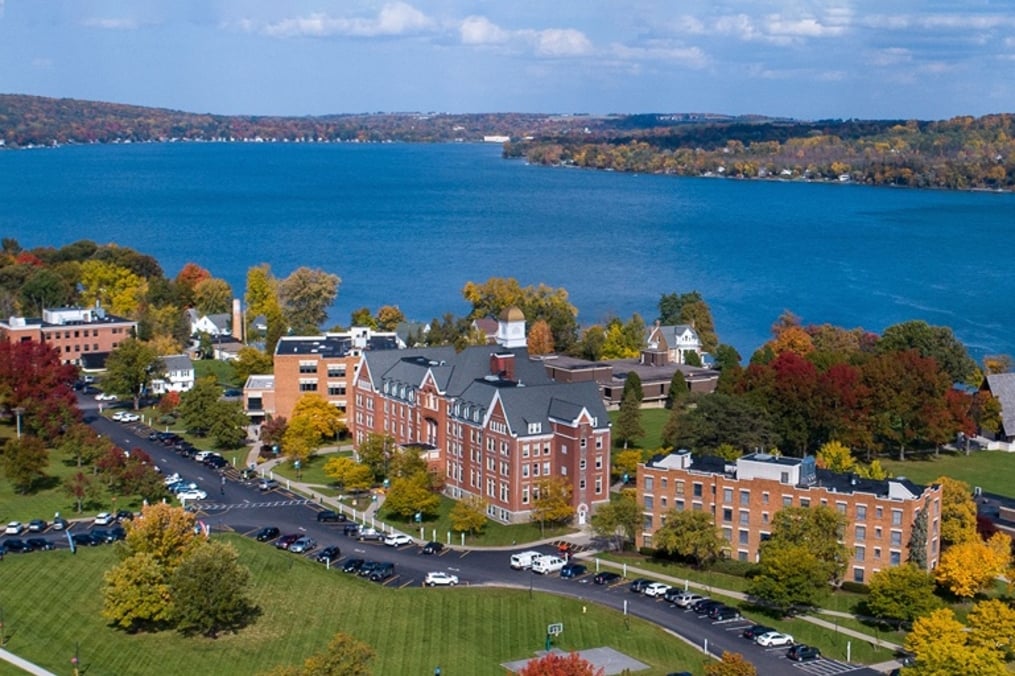
Keuka College is a small, hands-on liberal arts college perched on the shores of Keuka Lake in New York's Finger Lakes region. Known for its experiential 'Field Period' program requiring real-world work each year, Keuka emphasizes practical learning in health professions, education, and social work. With a 68% acceptance rate and a tight-knit campus where 74% of students live on-site, it offers a quiet, community-focused alternative to larger universities.
Admissions
Keuka College maintains a moderately selective admissions process with a 68% Acceptance rateThe share of applicants a college admits in a given year. A 10% acceptance rate means it admits about 1 in 10 applicants., admitting roughly two-thirds of its 2,901 applicants annually. The middle 50% of admitted students score between 940–1110 on the SAT or equivalent ACT scores, placing Keuka in the 'somewhat selective' category. The college operates on a rolling admissions basis, with no strict application deadline. Notably, 98% of first-year students receive need-based financial aid, with average awards around $6,304.
Sources
- Your Right to Know | Keuka College
- Common Data Set: Home
- Keuka College Overview - CollegeData
- [PDF] Common Data Set 2025-2026 - AggieData
- The Common Data Set: What It Is & How to Use It In College ...
- What is the Common Data Set? | College Raptor
- Keuka College SAT Scores and GPA - PrepScholar
- Keuka College Admissions - BigFuture College Search
- Keuka College Admissions - U.S. News & World Report
- Keuka College - Niche
- Keuka College - Tuition and Acceptance Rate - Peterson's