Loading…
← All schools
Johnson College
Scranton, PAprivate nonprofitwww.johnson.edu/
- Acceptance rateThe share of applicants a college admits in a given year. A 10% acceptance rate means it admits about 1 in 10 applicants.
- 98%
- Undergrad enrollment
- 590
- Net priceWhat a family actually pays after grants and scholarships are subtracted from the sticker price — usually far less than the published cost.
- $19,954
- In-state tuition
- $21,225
- Out-of-state tuition
- $21,225
- Location
- Scranton, PA
- Net Price
- $9,515
- Popular Majors
- Electrical Installers, HVAC, Construction
- Acceptance Rate
- 98%
- Graduation Rate
- 57%
- Avg. 1-Year Earnings
- $38,690
- Avg. 5-Year Earnings
- $48,634
- Student Aid Recipients
- 73%
Quick answers
- What is the acceptance rate at Johnson College?
- Johnson College's acceptance rate is approximately 98% (Scranton, PA), based on the most recent figures we compiled from public and primary sources.
- How much does Johnson College cost?
- At Johnson College, the average net price (after aid) is about $19,954 per year. Actual cost varies with financial aid and residency.
- How many undergraduates attend Johnson College?
- Johnson College enrolls approximately 590 undergraduate students.
- Where is Johnson College located?
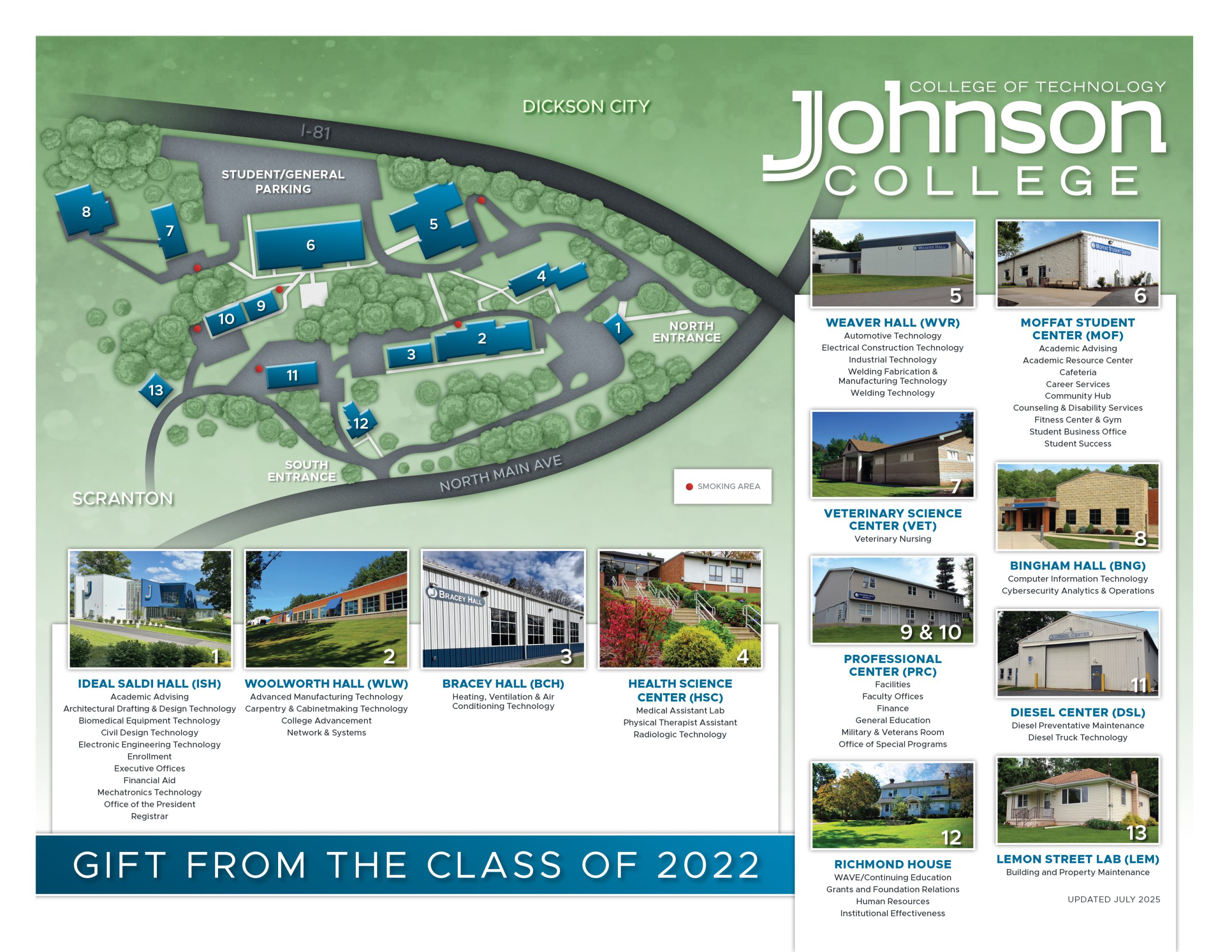
- Johnson College is located in Scranton, PA.
Johnson College in Scranton, PA, is a no-frills, career-focused technical college where nearly everyone gets in (98% acceptance rate) and graduates quickly enter the workforce. With specialized majors like Electrical Installers and HVAC leading to solid mid-career earnings (~$48k), it’s a pragmatic choice for students seeking hands-on training without the debt burden of a four-year degree.
Admissions
Johnson College is about as close to open enrollment as it gets, with a 98% acceptance rate—making it one of the least selective colleges in the U.S. There’s no SAT/ACT score cutoff (the school is Test-optionalA policy where you choose whether to submit SAT or ACT scores. If you don't, the rest of your application carries more weight.), and the average admitted student has a modest GPA around 3.5. The admissions process emphasizes accessibility: the college explicitly states it accepts 'qualified students regardless of race, religion, disability, or national origin.' For those who apply, the odds are overwhelmingly in their favor—just don’t expect cutthroat academic competition here.
Academics
This is a trade school at heart, with programs laser-focused on practical skills. The most popular majors are Electrical and Power Transmission Installers and , alongside other hands-on fields like and . Classes are small, and the curriculum is stripped of liberal arts fluff—this is a place where you’ll learn to fix an engine, wire a building, or weld a joint, not debate postmodern theory. Notably, Johnson offers ; it’s strictly a two-year associate-degree institution, with a graduation rate of (well above the 35% average for community colleges).
Sources
- Common Data Set: Home
- [PDF] Common Data Set 202
- Colleges Common Data Set - BS/MD Admissions by College ...
- The Common Data Set: What It Is & How to Use It In College ...
- Common Data Set: Your Key to Smarter College Decisions - nextfour
- Common Data Set - ccmrwithmsthrash
- Johnson College Admissions - BigFuture College Search
- Johnson University SAT Scores and GPA
- Johnson University Admissions - US News Best Colleges
- Johnson State College Admissions: SAT Scores & More - ThoughtCo
- 2029 Class Profile - Washington and Lee University