Loading…
← All schools
CUNY Bernard M Baruch College
New York, NYpublicwww.baruch.cuny.edu/
- Acceptance rateThe share of applicants a college admits in a given year. A 10% acceptance rate means it admits about 1 in 10 applicants.
- 48%
- SAT 25th-75th percentileThe middle range of SAT scores for admitted students: a quarter scored below the low number and a quarter scored above the high number.
- 1100–1400
- Undergrad enrollment
- 16,154
- Net priceWhat a family actually pays after grants and scholarships are subtracted from the sticker price — usually far less than the published cost.
- $3,033
- In-state tuition
- $7,464
- Out-of-state tuition
- $15,414
- Student Clubs
- 120+
- Acceptance Rate
- 48%
- In-State Tuition
- $7,461
- First-Gen Students
- 37%
- Most Popular Major
- Finance
- 6-Year Graduation Rate
- 63%
- Avg Early-Career Earnings
- $83,000
- Median Debt at Graduation
Quick answers
- What is the acceptance rate at CUNY Bernard M Baruch College?
- CUNY Bernard M Baruch College's acceptance rate is approximately 48% (New York, NY), based on the most recent figures we compiled from public and primary sources.
- What SAT score do you need for CUNY Bernard M Baruch College?
- Admitted students at CUNY Bernard M Baruch College typically score 1100–1400 on the SAT (the middle-50% range). Scores outside this band are still admitted, especially with strong applications.
- How much does CUNY Bernard M Baruch College cost?
- At CUNY Bernard M Baruch College, the average net price (after aid) is about $3,033 per year. Actual cost varies with financial aid and residency.
- How many undergraduates attend CUNY Bernard M Baruch College?
- CUNY Bernard M Baruch College enrolls approximately 16,154 undergraduate students.
- Where is CUNY Bernard M Baruch College located?
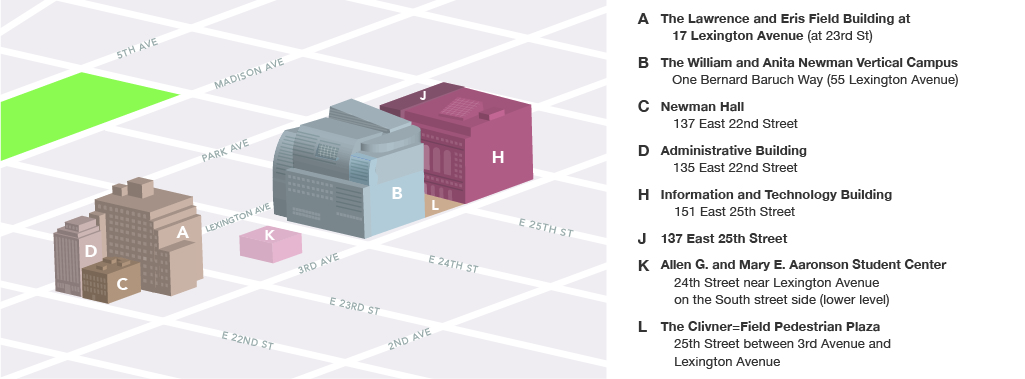
- CUNY Bernard M Baruch College is located in New York, NY.
CUNY Bernard M Baruch College is a powerhouse for ambitious, career-driven students who want a top-tier business education without the Ivy League price tag. Nestled in the heart of Manhattan, Baruch combines rigorous academics—particularly in finance and public affairs—with a scrappy, diverse student body that thrives on hustle. Its graduates routinely out-earn peers from far pricier schools, making it one of the best ROI plays in higher education.
Admissions
Baruch is selective but not cutthroat, with an Acceptance rateThe share of applicants a college admits in a given year. A 10% acceptance rate means it admits about 1 in 10 applicants. hovering around 48% ([7], [8], [11]). The school doesn't mess with the Common App—you apply directly through CUNY—and has been Test-optionalA policy where you choose whether to submit SAT or ACT scores. If you don't, the rest of your application carries more weight. since before it was cool ([6]). While there's no stated minimum GPA, insiders suggest aiming for at least a 2.5 to be competitive ([12]). Half of admitted students who submit SAT scores fall between 1170 and 1350 ([7]), but don't stress if your scores aren't stellar; Baruch cares more about your hustle than your test-taking skills.
Sources
- [PDF] Common Data Set 2024-2025 - Institutional Research
- Common Data Sets - Office of Institutional Research - CUNY
- [PDF] Common Data Set 2019-2020 - Institutional Research - CUNY
- Common Data Set Repository - College Transitions
- Common Data Set: Home
- CUNY--Baruch College - Profile, Rankings and Data
- CUNY--Baruch College Admissions - U.S. News & World Report
- CUNY Bernard M Baruch College Acceptance Rate - Admissions ...
- Baruch College SAT Scores and GPA
- CUNY Bernard M Baruch College - Sallie