Loading…
← All schools
Cal Poly Maritime Academy
Vallejo, CApublicmaritime.calpoly.edu
- Acceptance rateThe share of applicants a college admits in a given year. A 10% acceptance rate means it admits about 1 in 10 applicants.
- 95%
- Undergrad enrollment
- 804
- Net priceWhat a family actually pays after grants and scholarships are subtracted from the sticker price — usually far less than the published cost.
- $20,555
- In-state tuition
- $9,944
- Out-of-state tuition
- $22,544
- Location
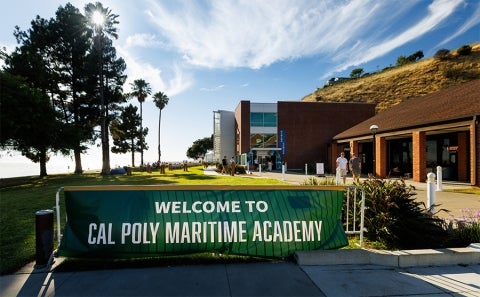
- Waterfront campus in Vallejo, CA
- Campus Housing
- Required for most undergrads
- Acceptance Rate
- 64-95% (varies by source)
- Undergrad Majors
- 7
- Notable Tradition
- Summer Sea Term voyages
- Job Placement Rate
- 94% within 3 months
- 4-Year Graduation Rate
- 50%
- Median Early-Career Salary
- $84,676
Quick answers
- What is the acceptance rate at Cal Poly Maritime Academy?
- Cal Poly Maritime Academy's acceptance rate is approximately 95% (Vallejo, CA), based on the most recent figures we compiled from public and primary sources.
- How much does Cal Poly Maritime Academy cost?
- At Cal Poly Maritime Academy, the average net price (after aid) is about $20,555 per year. Actual cost varies with financial aid and residency.
- How many undergraduates attend Cal Poly Maritime Academy?
- Cal Poly Maritime Academy enrolls approximately 804 undergraduate students.
- Where is Cal Poly Maritime Academy located?
- Cal Poly Maritime Academy is located in Vallejo, CA.
Cal Poly Maritime Academy is a no-nonsense, hands-on institution where students don uniforms, live on a waterfront campus, and graduate into high-paying maritime careers. With a pseudo-military structure, mandatory sea terms, and a 94% job placement rate, it's a boot camp for the global shipping industry—just don't expect frat parties or a typical college experience.
Admissions
Getting into Cal Maritime is more about meeting baseline requirements than competing against cutthroat applicant pools. Acceptance rateThe share of applicants a college admits in a given year. A 10% acceptance rate means it admits about 1 in 10 applicants. have fluctuated between 64% and 95% in recent years, with Niche reporting a 95% acceptance rate and CollegeTransfer.net noting 72%. Unlike most CSU campuses, SAT/ACT scores aren't considered for California high school applicants—admissions primarily evaluate GPA, with a 2.0 minimum threshold for in-state students. The school maintains a small, focused cohort; the Common Data Set (CDS)A standardized report most colleges publish each year with admissions, test-score, and financial-aid figures, making schools easier to compare. shows freshman classes typically number under 300 students.
Sources
- Common Data Set - CSUM - Cal Maritime Academy
- IR Dashboards - CSUM - Cal Maritime Academy
- Common Data Set - Institutional Research - Cal Poly, San Luis Obispo
- Facts + Figures | Massachusetts Maritime Academy
- Common Data Set Repository - College Transitions
- Institutional Research and Planning - CSUM - Cal Maritime Academy
- California State University - Maritime Academy Admissions - Niche
- California State University Maritime Academy: Statistics - EduRank
- First Time Freshmen - CSUM - Cal Maritime Academy
- California State University--Maritime Academy Admissions Stats